
New York (Knicks) State of Mind
Episode 15(?) in which we express significant concern about some upcoming sporting events, revisit our (mixed) record on prognosticating about the Iran War, update you on the impact of the anticipated mega-IPOs on index funds and discuss direct indexing, as well as IPO dynamics generally.

Do We Need Wemby To Win?
Despite being personally more interested in the upcoming World Cup (although preparing myself to be disappointed with the new format), the in media res NBA Finals are much more concerning from a financial markets perspective. After all, I am not sure the World Cup has any effect on (or correlation with) financial or economic success, I mean, see Argentina! Speaking of, can the Spurs get Manu Ginobli back to help shut down the Knicks' guards, is he too old now? But should we be concerned about the Knicks having a 2-0 (now 2-1) lead on the Spurs? I mean, we should all try and avoid superstitions, but…the market can definitely be emotional! And the last time the Knicks won the NBA finals was 1973 – a year with a decidedly poor short term market performance (the Dow lost about 45% over the course of the market crash). What happened in 1973? There was that pesky oil embargo of the US that OPEC imposed in response to the US’s support of Isreal in the Arab-Isreali (or Yom Kippur) war. So, yeah, there are some concerning similarities between 1973 and 2026. Now, of course, back in my March newsletter I noted that the US does not import as much oil as in the 1970s and so I wasn’t expecting the same stagflationary effects. But back then I thought the Oklahoma Thunder nee Seattle SuperSonics were going to repeat as NBA champions (I think the Manu joke showed you I don't follow the NBA that closely). But I do know that if the Knicks win the the NBA finals, it might be one similarity too many – history might not repeat, but even if it market merely rhymes with 1973, it could be a bumpy fall (particularly after the mid-terms). One possible glimmer of hope for the financial markets was that President Trump was going to (and did) attend the Knicks' home game yesterday (and, with the exception of Republican primary elections, he hasn’t exactly been on a winning streak). Knicks fans were (rightfully, it seems) worried he was bad luck, but were trying to take solace in the fact that at least the President wasn’t bringing SecDef Hegseth with him (though that may be because Hegseth was (I assume) permanently barred from MSG for over-consumption…I kid, I kid…James Dolan famously exclusively bars lawyers for representing clients that he is in litigation with!). But speaking of oil prices, President Trump, and SecDef Hegseth – yup, we have to revisit the Iran War, which is still going on, despite numerous peace deals having been mere hours/days away for multiple months now.
Oil Prices and the Iran War
I was not alone in thinking the Iran war would be short; many prognosticators had the same general thought that Iran would close the Strait of Hormuz, oil prices would start to spike, and President Trump would declare victory and chicken out in exchange for reopening the Strait (thus relieving oil/gas price pressure). And certainly, the President has tried to declare victory many times (and tried to declare the Strait open) despite all facts to the contrary! But one thing that has not happened is oil prices spiking as high as many industry experts were anticipating. Bloomberg’s Javier Blas thought that a war lasting several months would quickly result in oil prices in excess of $200. Other prognosticators were never as sanguine as I was about the US being able to put Humpty-Dumpty back together again; but those prognosticators foresaw even worse oil price increases and worried that the market would replicate 1973 in short order. But they were also wrong.
The stock market has continued to push higher, but the oil market hasn’t, even as the war drags on. What are we seeing? Analysts have identified many partial (or potential) reasons: China reducing its oil imports, oil releases from the US SPR, reduced sanctions on Russian oil, a combination of various other changes to behavior (Marketwatch had an ok round up). Others posit the oil market is merely continuing its forecast of a “TACO” that reopens the Strait before “too much” damage is done to oil infrastructure in the region. It’s probably a combination of them all, of course, although I do see some progress in Trump’s recognition that he needs to exert control over Netanyahu if he wants any ceasefire to hold. Hence, Trump’s frustration and apparent claim that he is the only one “keeping Netanyahu out of jail”. If only he had read my Easter Newsletter in which I speculated that the best path to peace was getting Netanyahu an apartment in Trump Tower and a non-extradition agreement! So, I do remain cautiously optimistic that the Iran War will ultimately be resolved and the Strait reopened without a 1973’s oil shock and stagflationary cycle ripping through economy…(Late Update: particularly with the Spurs pulling out Game 3)! But we may also simply be seeing a fantastic example of a market pretending something is no big deal until that risk is, no longer a big deal (in this case because the Strait is opened).
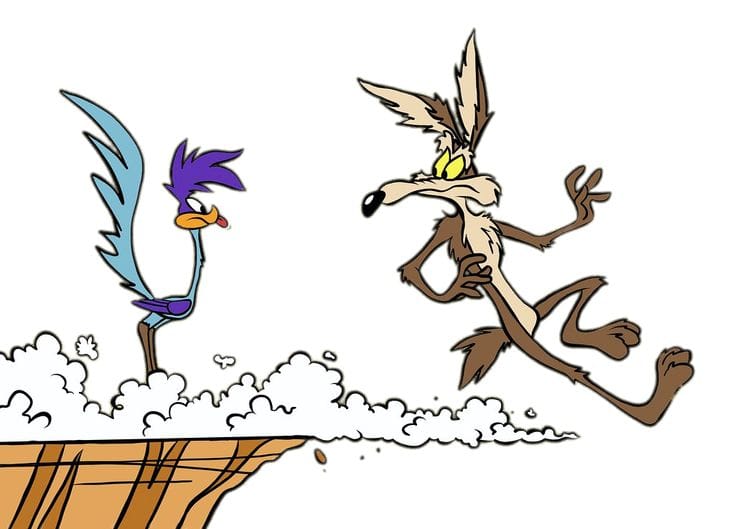
Like Saturday morning cartoons, the stock market keeps running full steam ahead without looking down. Which might make you nervous when you remember that realization comes to the coyote in those cartoons with a typically abrupt “correction”. The difference here is that the oil market is frantically trying to build a bridge – and if we don’t look down for long enough…who knows, maybe there will be a bridge there by the time we do? So for now, I am trying to continue to ignore the war when it comes to any investing decisions or concerns about the economy. I’ll admit though, I find it easier to ignore the potential oil shock when my concerns about the stock market (and yes, I am actively distinguishing between the stock market and the economy here) are more focused on excessive AI valuations and the potential for several of the upcoming IPOs to be even more insanely valued. But before we get there, a musical break is in order, and to prove how unworried I am about a 1973’s repeat in the economy, I figured we could repeat some 1973 hits – although you’ll be unsurprised that I am not simply picking the top charting single of 1973 (not a great song and too much war!)
Musical Interlude:
There are a few good songs (amongst a variety of….well, I guess I'll just describe them as not as good songs) across a wide mix of genres (here is Wikipedia’s Top 100 list), and if I were limited to picking the best songs, I’d probably be highlighting some Paul Simon’s contributions (Kodachrome; Loves me Like a Rock) or a song which did not make the list (Lou Reed’s Walk on the Wild Side, which charted in 1973 (but not enough to make the top 100), and was released in 1972 in any event). Instead, I’ll be self-indulgent and highlight two songs which are still kind of fun: the first written by one of my favorite childhood authors (and recently-ish covered by two of my favorite musical artists, Corb Lund and Hayes Carll) and the second which I associate with one of my favorite child-hood movies (Sneakers).
Cover of the Rolling Stone: written by Shel Silverstein (yes, that one). Well, worth a listen, and I prefer the version by Corb and Hayes to the 1973 version that was a hit for Dr. Hook and the Medicine Show (and God help us if we get a 1973 style repeat based on Dr. Hook).
Jim Croce’s only #1 hit, and not actually “Motown”, but certainly influenced by the Motown sounds/vibes at the time. Not my favorite song, but I can’t help but remember the movie Sneakers, which uses a terrible cover of this song as the lead-in for a wonderfully dreadful (and hilarious) fake date. The original is above, and the short Sneakers clip is here.
“It’s all just electrons”
That is from Sneakers, of course, since all my references can’t be high-brow Proust or James Joyce references (and if you haven’t noticed all the Proust references sprinkled liberally through my previous newsletters, then that’s definitely on you – maybe you are overdue for a quick beach re-read of Remembrance of Things Past? And, as you have recognized already, all of my newsletters are one enormous homage to Joyce’s stream of consciousness). “The world isn't run by weapons anymore, or energy, or money. It's run by little ones and zeroes, little bits of data. It's all just electrons.” Robert Redford (to whom the line was delivered) was unswayed (line is at 1:30ish). But the market is starting to approximate this old line from Sneakers. Because we are (besides the “normal” AI bubble in NVIDIA, and Micron, and Sandisk, and WD, and…etc.) at the beginning of a potentially massive string of IPOs for SpaceX, Anthropic, and OpenAI, which might mean that the market is going to be based almost entirely on electrons by the end of the year! The SpaceX IPO process is well underway, as they were expected to close their order book for institutional buyers (maybe at 4x oversubscribed) maybe as soon as Wednesday after the market closes (which is hopefully after this newsletter finally goes out! [VERY LATE UPDATE: ARGH!]. Anthropic “confidentially” filed their S-1 last week. And Open AI “confidentially” filed their S-1 just this past Monday. We discussed the SpaceX IPO last newsletter, as I expressed hope that not every index would give into their demands for early inclusion (right now, it appears only Nasdaq and the Russell Indexes have caved). Instead, the big news is that the S&P decided that they would NOT relax rules that would get SpaceX (and thus presumably Anthropic and OpenAI as well) early inclusion into the index. This is a good thing, narrowly, since so many index investors are invested in indices that follow the S&P, but it also seems a little like the horse has left the barn, given the number of articles about index investors being concerned with either getting exposure to (or ensuring that they don’t get exposure to) SpaceX stock (particularly, without “seasoning”) and based on the number of clients expressing some concern about this to me as well. Why? Because many articles unpacking the S&P decision are presenting it as an “active choice” by the S&P to some extent (even worse are the few that have presented it as a gamble by the S&P or noted that they may regret it if SpaceX rockets up and their index lags other indices). Which is, I have got to note, is some very unfortunate framing for S&P; i.e. one could frame this as a craven and weak-willed move by Nasdaq and the Russell! And you could then compare them to the various universities and law firms which cravenly caved to Trump’s demands early last year, I mean, if you wanted to be really vicious, you could remind your readers those schools (Columbia, cough, cough) and law firms (Paul Weiss, cough, cough) gave in way to easily which was a pretty terrible decision (I think CNBC had some analysis highlighting it as a business rationale for Nasdaq). I’ll skip that comparison, of course, as I want to focus on the investing world here.
I am still frustrated that some of the indices will be (very likely) skewing apart from each other at this point. There are a couple of reasons for this. One reason, mentioned last time, is the philosophical point that no index investor wants to do investigate what policies their index fund takes towards new issues and/or how often and when the index will relax those policies. That is why they are index investors! But there are some other points too. One is the impact that this divergence in rules for indexes might ultimately have on the ability/desire to “tax loss harvest” using different ETFs (though I hope no one is using the S&P500 and the Nasdaq as similar indexes even before this news, of course). Conceptually, many ETF investors (in their taxable accounts) were able to efficiently tax loss harvest (“TLH”) in times of great volatility by moving between ETFs which technically tracked different indices but which [stop reading if you work for the IRS or are a Tax Court judge] are economically the same. But the ease of TLH was due to indices being economically very similar – you could book a tax loss on one ETF, and rebuy into another the same day, which left you with the exact same economic exposure to the upside (most of the indices that purported to track the same things are very, very highly correlated). But now, TLH by moving between indices which purport to track the same things (“Large Cap US companies”) could be significantly different if one of those has relaxed the rules to allow SpaceX, Anthropic and OpenAI early inclusion into their index. It is a new world for index investors. Which leads me to a second point, again frustrating to me (although probably not to most financial advisors) that while I like to preach simplicity, “direct indexing” may well become more and more appealing if all the different indices available in ETF form have different approaches (especially if that depends on how close of a friend their chairman is with Musk, Altman, or Amodei). Although direct indexing can make sense for certain investors, I wouldn’t characterize it as “simple”. But, nonetheless, it will be harder to recommend blindly picking an index fund ETF if, as noted above, I (or you) have to research different early inclusion rules and what specific company or IPO that index’s rules will (or won’t) allow, and which point, presumably I (or you) then evaluate that company as well? Ugh. Why not just use a direct indexing product that allows an exclusion of certain stocks and skip trying to understand the early inclusion rules, and just pick the companies you want to exclude (or include) yourself? For more, you can read the sidebar, but if you want to get to the IPOs or are trying to stay awake, you should probably skip it.
The AI IPOs:
One thing to note from the outset is that SpaceX, OpenAI and Anthropic are all “AI” companies. But wait, some of you might think, SpaceX is a rocket company that makes really good re-usable rockets, that’s why it is based in Starbase, Texas (which is all true). And many of you might think, no…it’s not just rockets, it’s also Starlink, which is making tons of money. That is also true. But SpaceX had previously bought xAI, Elon’s standalone AI company, which already had merged with X nee Twitter (in a somewhat controversial deal that coincidentally was at the same price that Musk personally paid for Twitter years before, a price so high that Musk had to be sued by Twitter after he tried to get out of the deal when he realized he overpaid). [Breathe, relax, ok...I am ready...] And SpaceX’s sky-high valuation (it will be a stock 40% more “expensive” than the previously most “expensive” stock, when using price to sales metrics) is primarily based on expected revenue coming from the AI portion of the business. I could spit numbers at you, but the Morningstar article I just linked has better graphics designers, so you could just go look at their bar graphs. So SpaceX is crazily, insanely, ridiculously overvalued at its offering price. It will almost assuredly spike at some point in time after the IPO (making some people some short-term gains, as well as Elon Musk a trillionaire), but investing is a long-term game. And this is where I’ll expand to OpenAI and Anthropic – none of these IPOs are appropriate for long term investors (at their expected price/valuations) to purchase via an IPO allocation (or worse, buying on the first day!). And there are very good reasons to be somewhat skeptical of the AI valuations anyway (you can read about them elsewhere); the skeptics go into detail about various valuation metrics and inherent expectations and whether AI will become a commodity etc. etc. etc. Instead I want to highlight a more overarching concept that the IPO is simply NOT designed for you (assuming you are a normal, long-term investor with a high earning job, or in my case a partner with a high earning job, trying to build wealth/retire early/etc., though, of course, if the job in question is a job at one of those companies then the IPO is going to be great for you!)). The IPO is designed to (i) cash out early investors, employees and insiders and/or (ii) raise more money for growth; the precise split between those two depends on the company doing the IPO, but generally speaking IPOs have more recently trended toward the first purpose (since private equity and venture capital have grown to take a bigger percentage of the second purpose). So why would you want to participate in that? The game is literally being rigged against you (long term investor), because the early investors, employees, and insiders want to get the highest price they can! And that is great! They should – for many it is life changing money and, sometimes, a well-earned long-time-coming payoff for a career of work and risk-taking.
But to be clear, I am not claiming IPOs are “rigged” in some sort of illegal conspiracy…I am saying it is rigged because the mechanics of an IPO would be considered market manipulation in other contexts. What do I mean? Well, how about the “greenshoe option” – which is an agreement between the issuer and its banks that allows banks to sell shares they don’t have with the explicit purpose of trying to manipulate the price (it works like this). Or the various lock-up agreements with insiders, executives, and employees (where insiders agree with banks NOT to sell their shares for 90, 180, 360 days etc. in an explicit bid to prevent any downward price pressure on the stock. Or the allocation agreements various brokerages/investment banks make with some of their largest customers (sometimes explicit, sometimes implicit) to determine their allocations (i.e. if you “flip” the stock right away by selling for a short term gain, you typically don’t get as big an allocation next time, because your selling is creating some downward price pressure). Not to mention, the entire concept of investment banks pitching their services to a potential IPO company: how they will market the stock, how many buyers they can line-up, and how high a price they can get and sustain (until those lock-ups expire at least!). There are obviously countervailing market dynamics (i.e. the big customers of these brokerages are pissed if every IPO tanks; hence bankers try very, very hard to avoid the stock dropping below the IPO on the first day/week). Also, if you saw the Andreesen-Horowitz article linked above you saw the contrary complaint - bankers are underpricing IPOS to screw over founders (unsurprising position for Andreesen-Horowitz, I suppose). But the overall system is one that is fundamentally misaligned with what you, as a long-term investor, are interested in and would benefit from! And that is in the best-case scenario that the companies are priced somewhat reasonably for their growth prospects. For an industry which we really don’t know much about from a long-term perspective, the regular IPO risks are just magnified! After all, OpenAI might not be worth anything if Deepseek (a significant Chinese competitor) releases some new groundbreaking algorithms which use 1/10 the energy of OpenAI’s algorithms. And, remember, there are more Teslas in space than there are SpaceX data centers in orbit right now, even though that is the majority of the valuation for the SpaceX IPO (as noted above). So, yeah, IPOs are just not for me or you. Which is fine! Unless, of course, our index funds start putting us into IPOs without appropriate “seasoning” to let those options and lock-ups and profitability develop!
But one all around positive story out of the IPO news I’ve seen is this one, about SpaceX employees banding together to demand lower rates on financial management to help them with their newfound wealth! I love that that they are aiming to get their fees down to at least 0.50% AUM from the still typical (and horrifyingly high) 1.00% AUM by basically running an employee money management RFP with a number of firms. I assume my copy of that RFP was just slightly delayed because I live on an island, but I am sure it will get here soon. It is getting awfully close the IPO date though…hmmm. I mean, jeez, I think the countdown to the SpaceX IPO is starting soon.
Countdown to SpaceX! Ok, speaking of countdowns, we should wind up with another 1973 chart topper, though topper is maybe a bit generous since it just barely made the top 100 at #97! Interestingly, it was first released in 1969 (in the UK and US), then re-released in 1972 in the US, but it seems like the only time it hit the Top 100 was in 1973? Yup, it’s David Bowie’s Space Oddity!
I think Bowie said it best for the SpaceX IPO buyers: Check ignition and may God's love be with you.